As an Amazon Associate we earn from qualifying purchases. Product links on this page may be affiliate links.
Last reviewed: November 2026. Sources last checked November 2026.
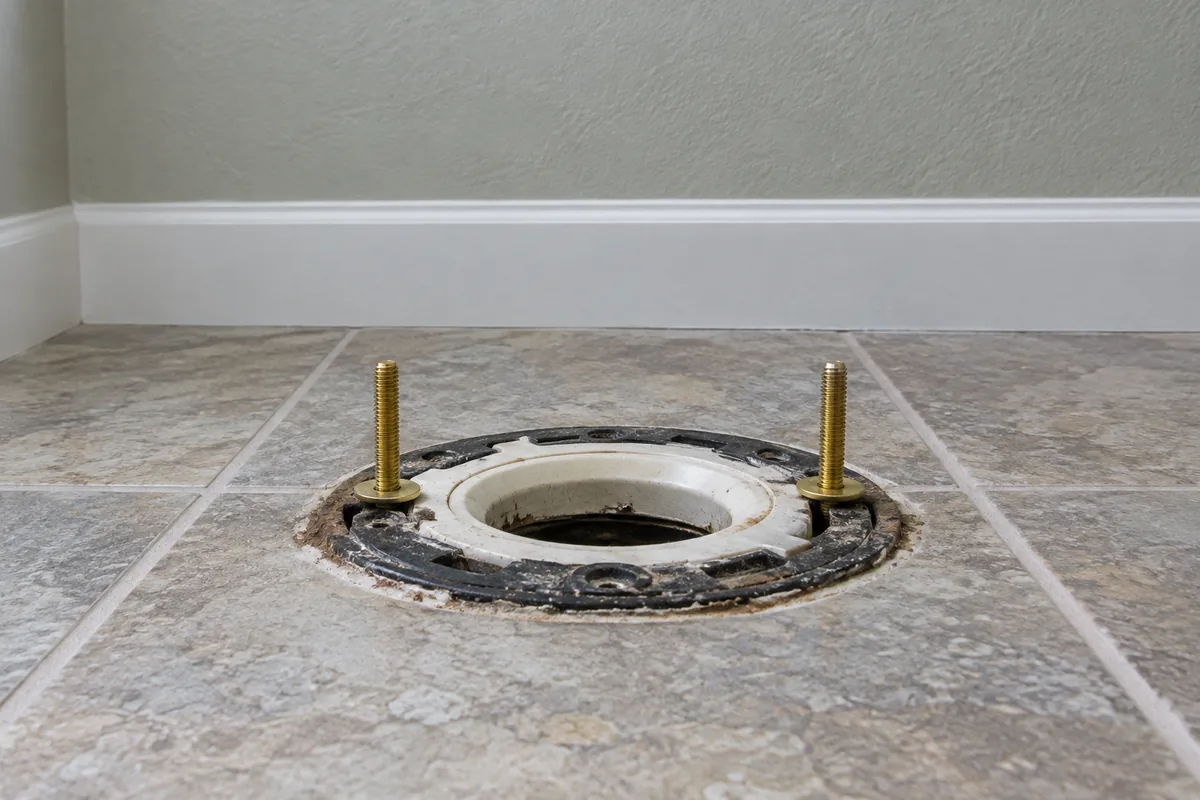
A toilet's rough-in is the distance from the finished bathroom wall to the center of the drain opening (the flange). Measure to the center, not to the edge of the pipe. If the toilet is still in place, measure from the wall to the center of one of its mounting bolts instead. The most common distance is 12 inches; 10 and 14 inches turn up in older homes and in smaller or differently laid-out bathrooms. The number you need is printed on every toilet's spec sheet, so once you have measured, you can match it.
Everything below comes from the manufacturers' own pages, manuals and spec sheets (TOTO, American Standard and Kohler), and each figure is linked. We have not tested any toilet.
Table of Contents
What the rough-in measures
TOTO defines it as "the distance between the back of the bathroom's finished wall and the center of the toilet drainpipe's opening, which usually has a plastic or cast iron lining, called the flange" (TOTO, toilet rough-ins). The wording differs a little from maker to maker, but the start and end points are the same:
- TOTO's installation manual: "the distance between the finished wall to the center of the closet flange" (TOTO Drake installation manual).
- American Standard's product page: "Measurement from the finished wall to the center of mounting holes on the floor flange" (American Standard Cadet 3, 10-inch rough-in).
- American Standard's spec sheets: "from finished wall to C/L of outlet", where C/L is the centerline (American Standard 215F spec sheet).
Two things follow. The wall is the finished wall, the surface you see, not the rough framing behind it. And the baseboard is not part of the measurement: American Standard says most toilets bolt to the floor 12 inches from the wall "(not counting the baseboard)" (American Standard, how to choose a toilet). We found no maker text on how to treat tile or wall panels.
How to measure it
If the toilet has been removed
TOTO's steps: find the drainpipe in the floor, which "will typically have a plastic or cast iron lining called the flange," then "measure the distance from the back of the bathroom's finished wall to the center (not base) of the toilet drain pipe/flange" (TOTO).
If the toilet is still installed
TOTO again: "If the toilet is still installed, measure the distance between the back finished wall and the center of one of the toilet's mounting bolts." Those are the two bolts at the base, usually under small caps.
Check the result
TOTO says the distance "should be close to 10", 12", or 14". If not, measure again." That is the useful sanity check: a reading far from all three is a reason to measure again. We found no manufacturer text on what to do with a reading that really falls between those sizes, so we do not guess. If you keep getting an in-between number, have a plumber look at the pipe.
What 10, 12 and 14 inches mean
The rough-in decides how far the toilet's drain sits from the wall, and with it how far the back of the toilet sits from the wall.
- 12 inches is the common one. TOTO calls it "the standard (or at least most common) toilet rough-in distance today." American Standard says "most toilets bolt to the floor 12-inches from the wall" (links above), and Kohler lists its Cimarron K-3589 as a "Standard 12" (305 mm) rough-in" (Kohler K-3589 spec sheet).
- 10 inches is "more common for smaller apartment bathrooms or powder rooms," in TOTO's words. It is a shorter distance, so the toilet sits closer to the wall.
- 14 inches is the longer one. TOTO says older homes, "and even modern homes," may have 10 or 14 inches "depending on the size and shape of the bathroom."
For the models that fit those two less common sizes, see toilets for a 10-inch rough-in and 14-inch rough-in toilets.
How to tell what rough-in a toilet needs
TOTO: "All toilets have specifications that tell you the rough-in measurement." Spec sheets and product pages give it in a few forms.
As a line on the spec sheet
The Kohler K-3589 sheet lists "Rough-in: 12" (305 mm)" and marks "12" (305 mm) CL of Toilet" on its drawing. A 10-inch TOTO sheet carries the number in its title: "Drake Two-Piece Toilet, 1.28 GPF, 10" Rough-In" (TOTO SS-02051). GPF is gallons per flush, the water the toilet uses in one flush; it is on the sheet but has nothing to do with whether the toilet fits. Water use and flush scores are covered in best flushing toilets by the numbers.
In the model number
TOTO's manual says: "Models with 10" rough-in have model numbers ending with ".10", for example C776CEFG.10." So a TOTO model ending in ".10" is the 10-inch version of that toilet. The same manual adds that for the toilet to fit, the rough-in "must be at least 12 inches for most models." That is TOTO's statement about its 12-inch toilets, not a rule for every brand.
In a table by model
Some makers list several rough-ins for one toilet. American Standard's installation guide for its Cadet 3 series has a chart where dimension "A" is the rough-in and "B" is the bowl height (American Standard Cadet 3 installation guide):
| Bowl | Rough-in "A" | Bowl height "B" | Model |
|---|---|---|---|
| Right Height elongated | 12" (305 mm) | 16-1/2" | 270AA |
| Right Height elongated | 10" (254 mm) | 16-1/2" | 270AB |
| Compact Right Height elongated | 14" (356 mm) | 16-1/2" | 270FC |
| Elongated | 10" (254 mm) | 15" | 270CB |
| Round front | 12" (305 mm) | 15" | 270DA |
| Round front | 10" (254 mm) | 15" | 270DB |
Source: American Standard installation guide for the Cadet 3 (270) series, selected rows, checked November 17, 2026. The rows show how a spec sheet gives the same toilet at different rough-ins; they are not a buying list. American Standard's own page for the 10-inch elongated Right Height model (270AB) is marked "Discontinued", and we did not check the others. Right Height is American Standard's name for its taller bowl; the bowl-height column is covered in comfort height vs standard toilets.
As a minimum
Read the wording on the sheet. American Standard's spec sheet for its 14-inch Cadet PRO says "this toilet is designed to rough-in at a minimum dimension of 356mm (14") from finished wall to C/L of outlet", and its 10-inch Cadet 3 sheet says the same with 254 mm (10") (American Standard 270D spec sheet). The point is that the number is a minimum distance from the wall, so a wall closer than the number does not work. Those sheets do not say what happens when the wall is farther away, and we do not assume it.
TOTO's 10-inch sheet adds a note on the wall gap: "To maintain adequate wall gap between the back of the tank and wall, mount the floor flange at a nominal 10" rough-in distance." The flange position matters to the gap behind the tank as well as to the fit.
If your measurement is 10 or 14 inches
Match it. TOTO's advice is to buy a toilet "with the exact rough-in measurement as the original toilet," because changing the rough-in means opening the floor, "which may entail breaking through the concrete," and dealing with the water line and drain line (TOTO).
On the mismatch itself, TOTO says that replacing a 14-inch rough-in toilet with a 12-inch one "will leave a sizable gap between the toilet tank and the bathroom's finished wall." The other direction is the fit problem described above: TOTO's 12-inch toilets need at least 12 inches. TOTO's own workaround is an adapter: its Unifit rough-in "will replace the lower half of your new TOTO toilet's trapway and adapt to the existing rough-in distance," on select TOTO skirted toilets. That applies only to those TOTO models; it is not a general fix.
- With a 10-inch rough-in, go to toilets for a 10-inch rough-in. a search for 10-inch rough-in toilets on Amazon shows what is sold online the day you look; check the rough-in on each listing against the maker's sheet.
- With a 14-inch rough-in, go to 14-inch rough-in toilets.
- With 12 inches, you have the widest choice, since this is the standard size. The height of the bowl is the next thing to decide, and comfort height vs standard explains it.
A short checklist
- Measure from the finished wall (not the baseboard) to the center of the flange, or to the center of a mounting bolt if the toilet is in place.
- Check that you got close to 10, 12 or 14 inches; if not, measure again.
- Find the rough-in on the spec sheet, and look at the model number: in TOTO's Drake manual, the 10-inch models end in ".10".
- Check whether the sheet gives the rough-in as a minimum distance from the wall.
- Keep the same rough-in as the old toilet unless you are ready to open the floor.
Sources
TOTO: toilet rough-ins and Unifit; Drake installation manual; spec sheet SS-02051. American Standard: Cadet 3 product page; Cadet 3 installation guide; 270D spec sheet; 215F spec sheet; how to choose a toilet. Kohler: K-3589 spec sheet. All pages checked November 17, 2026.
If you'd like to read other articles similar to Toilet Rough-In: How to Measure It and What 10, 12 and 14 Inches Mean You can visit the category Rough-In Sizes.
You may also enjoy reading